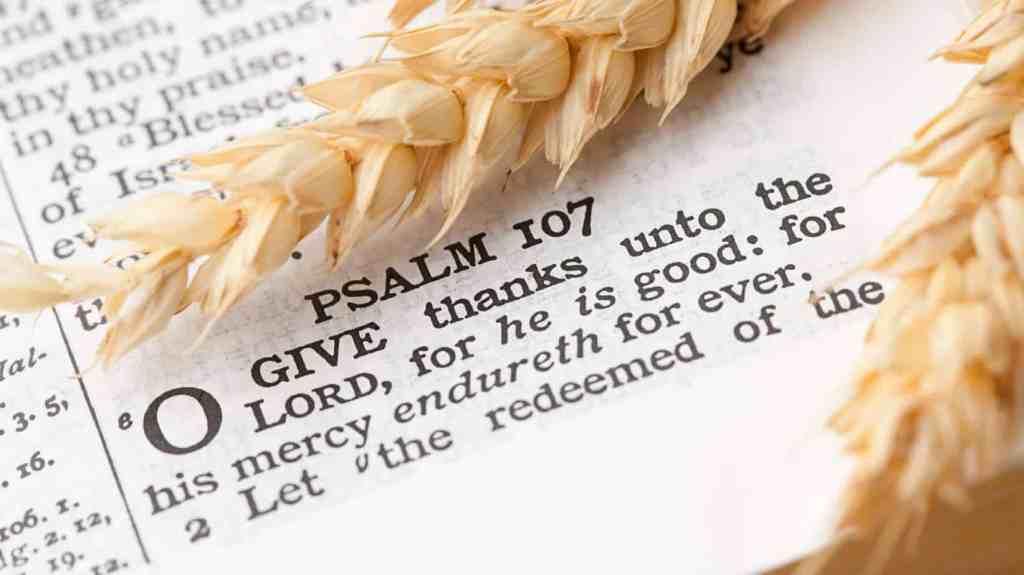
Oh come, let us sing to the Lord! Let us shout joyfully to the Rock of our salvation. Let us come before His presence with thanksgiving; let us shout joyfully to Him with psalms. Psalm 95:1-2
Recommended Reading: Psalm 100:1-5
100 “Make a joyful shout to the Lord, all you lands!2 Serve the Lord with gladness;Come before His presence with singing.3 Know that the Lord, He is God;It is He who has made us, and not we ourselves;We are His people and the sheep of His pasture.
4 Enter into His gates with thanksgiving,And into His courts with praise.Be thankful to Him, and bless His name. 5 For the Lord is good;His mercy is everlasting,And His truth endures to all generations.”
COMMENTS: When we read about Joseph’s , Daniel’s, Esther’s, Noah’s, Jeremiah’s, Elijah’s, Elisha’s, Ruth’s, David’s, Moses’, … lives in scripture, we soon discover a pattern. God is always faithful to and present in the lives of those who love and seek and obey him. He provides for and protects and saved them, but often let’s his beloved children go through a time or even a number of times of suffering without feeling God’s comforting presence. God often withholds evidence that He is near so His children must rely on their trust and faith in Him to sustain them until time of testing is over. But that time does always close when God chooses and then blessing and abiding sense He is near comes.
God assures us (Romans 8:28) that even evil deeds of others can not permanently harm us and God will always use even those deeds to bring His blessing to us.
The story of Squanto is such a story. One that has been forgotten in our schools but a story of God’s hand at work through the deeds of His faithful followers and even through the evil deeds of sinful men. I include a summary story of Squanto at end of this devotion.
Squanto endured great suffering at hands of evil explorers who captured and sold Squanto as a slave. But those deeds saved Squanto from death and put him in a place to learn English and learn about God’s love so he could later help the Christian pilgrims survive and prosper and evangelize in the hostile American colonies.
Great evil has been done on the American Indians but Christ has been shared with them and many have been saved. Christ’s example hasn’t been showed to them by all but God’s Will and influence has prevailed and will always either in spite of or because of conduct of His followers.
So, what is the legacy you are building and leaving? Will it be the evil legacy of Captain Hunt and others like him or of those Friars and Pilgrims? Will it be of Saul’s life before he encountered the risen Christ on the Damascus Road or of Paul after that encounter?
We have so much to be thankful for as we enter the Thanksgiving and Advent season. 2020 has been a year of disasters and life changing affects of Covid 19. Many have become sick and died due to Covid 19.
I believe Covid 19 is evidence that God’s protective hand has been removed from America and world because we have been unfaithful to Him, like Israel when Babylon invaded and took them captive. I believe we are approaching and possibly about to enter the time foretold in scripture of great tribulation.
If that is true, we should expect and prepare for times getting much worse. Some would suggest buying guns and ammunition and stocking up in food and water. Some would suggest moving to safe areas.
So what does God suggest? How did He prepare those before us as they entered a time of tribulation and God’s judgment?
Noah lived in such a time preparing for and coming out on the other side of the great flood. Daniel and Jeremiah prepared for Babylon even though they had no idea when and what that would entail.
But they all followed God’s instruction and remained faithful to Him step by step watching God’s Will and God’s Plan unfolding day by day. Daniel could not know how that would unfold even though he knew it would be 70 long years before Israel could return from Babylon as captives in a pagan land.
What will 2021 bring us? God’s warning and instruction hasn’t changed. He requires 2 Chronicles 7:14 “14 if my people who are called by my name ghumble themselves, and pray and seek my face and turn from their wicked ways, then I will hear from heaven and will forgive their sin and heal their land.”
Daniel was faithful and thankful in the midst of the Lion’s Den and all during those 70 years of captivity. His 3 friends were faithful and thankful as they were being thrown into a hot furnace. We must be thankful in the midst of whatever God allows to come our way, but in order to again avoid God’s judgment, we must humble ourselves and pray and repent of our wicked ways and give Him the love and praise and worship and obedience that He deserves from us and also requires of us.
Will we willingly bow before Him or be forced to in judgment. Satan and his followers will do so in judgment. We have the option of doing so now in praise and worship honoring the Christ who suffered and died for us.
God has given us the privilege to choose. If we choose Him, He promised eternal life and a wonderful eternal home with Him. There is only one way, Christ’s way, to eternal life. No other way is sufficient or will work. One way is enough, we just need to believe God’s Word and follow that way provide by God Himself at great cost to Him
I invite you to look up and read again the stories of those mentioned above in scripture. Then read the story of Squanto below and note God’s hand at work in all these examples. Then reflect on similar examples from your family and community and maybe in your own experience.
Let this Thanksgiving and Advent season be your time to follow 2Chronicles 7:14 and repent and seek God anew for Revival first in us and then in our community and country and world. He will as we and those we influence repent and follow Him anew too. I believe there were times in history when we were at the cliff of God’s judgment and great tribulation. I believe WWII was such a time. But since then we are neglecting God and His commands and showing contempt for His law, for life, for God – even denying God’s existence. Scripture tells us in the last days good, as God defines in scripture, will be judged evil and evil, as scripture defines it, will be judged as good (Isaiah 5:20 & Romans 1:18-23). Scripture also tells us in the last days Christ will come to stop man from completely destroying himself. Matthew 24:22 ““If those days had not been cut short, no one would survive, but for the sake of the elect those days will be shortened.”
In America, Thanksgiving has it’s roots in 1621 when the Pilgrims celebrated the first harvest in their new world. Abraham Lincoln in 1863 in the midst of Civil War declared Thanksgiving Day to be a national holiday. But God’s command to be thankful goes back to ancients recorded times in scripture. When Israel failed to be thankful, they lost God’s protective hand and endured God’s judgment at the hands of godless neighbors.
The way to give thanks was expanded from the Old Testament to the New. In the Old Testament, God was normally thanked “for” things—His works, attributes, and blessings (Psalm 106:1). While that focus is maintained in the New Testament, it is expanded to giving thanks “in” all things (1 Thessalonians 5:18). That is, in all circumstances. We can do that because we know God causes “all things” to work together for our good (Romans 8:28).
Why not do both today? Give thanks to God for His blessings and give thanks for whatever circumstances you are experiencing. Fill this day with thanksgiving to God.
“Almighty God, Father of all mercies, we, thy unworthy servants, do give thee most humble and hearty thanks for all thy goodness and loving kindness to us, and to all men. “ Book of Common Prayer
THE STORY OF SQUANTO:
Squanto: The True Story Of The Native American Behind The First Thanksgiving
By Gina Dimuro
As the last survivor of the Patuxet tribe, Squanto used his fluency in English and his unique relationship with the Pilgrim settlers at Plymouth to increase his own power and influence.
Samoset, one of the first Native Americans to meet the Pilgrims, famously introduced them to Squanto.
Ever heard the tale about the first Thanksgiving in 1621? As the story goes, the English Pilgrims meet a “friendly” Native American named Squanto in Plymouth, Massachusetts. Squanto teaches the Pilgrims how to plant corn, and the settlers enjoy a hearty feast with their new native friend.
But the true story about Squanto — also known as Tisquantum — is far more complex than that.
Who Was Squanto?
Schoolchildren are taught that Squanto was a friendly native who saved the Pilgrims, but the truth is complicated.
Historians generally agree that Squanto belonged to the Patuxet tribe, which was a branch of the Wampanoag Confederacy. It was located near what would become Plymouth. He was born around 1580.
Although little is known of his early life, Squanto came from a village of hardworking and resourceful people. The men of his tribe would travel up and down the coast on fishing expeditions, while the women cultivated corn, beans, and squash.
Before the early 1600s, the Patuxet people generally had friendly contact with the European settlers — but that certainly didn’t last long.
At some point during his youth, Squanto was captured by English explorers and taken to Europe, where he was sold into slavery. The most widely-accepted theory is that Squanto and 23 other Native Americans boarded the ship of Captain Thomas Hunt, who put them at ease with promises of trade before setting sail.
Instead, the Natives were held captive aboard.
“This is not revisionist history,” said Wampanoag expert Paula Peters in an interview with Huffington Post. “This is history that’s just been overlooked because people have become very, very comfortable with the story of happy Pilgrims and friendly Indians. They’re very content with that — even to the point where no one really questioned how is it that Squanto knew how to speak perfect English when they came.”
The Patuxet people were outraged by the kidnappings, but there was nothing they could do. The Englishmen and their prisoners were long gone, and the remaining people of the village would soon be wiped out by disease.
Squanto and the other prisoners were likely sold by Hunt as slaves in Spain. However, Squanto somehow managed to escape to England. By some accounts, Catholic friars may have been the ones to help Squanto out of captivity. And once he was free in England, he began to master the language.
Mayflower Pilgrim William Bradford, who got to know Squanto very well years later, wrote: “he got away for England, and was entertained by a merchant in London, employed to Newfoundland and other parts.”
William Bradford befriended Squanto and later saved him from his own people.
It was in Newfoundland that Squanto met Captain Thomas Dermer, a man in the employ of Sir Ferdinando Gorges, an Englishman who helped found “the Province of Maine” back on Squanto’s home continent.
In 1619, Gorges sent Dermer on a trade mission to the New England colonies and employed Squanto as an interpreter.
As Squanto’s ship approached the coast, Dermer noted how they observed “some ancient [Indian] plantations, not long since populous now utterly void.” Squanto’s tribe had been annihilated by the diseases that the white settlers had brought with them.
Then, in 1620, Dermer and his crew were attacked by the Wampanoag tribe near modern Martha’s Vineyard. Dermer and 14 men managed to escape.
Meanwhile, Squanto was taken captive by the tribe — and he was longing for his freedom yet again.
Squanto Meets The Pilgrims
In early 1621, Squanto found himself still a prisoner of the Wampanoag, who cautiously observed a group of recent English arrivals.
These Europeans had suffered grievously in the winter, but the Wampanoag were still hesitant to approach them, especially since Natives who attempted to befriend the English in the past had been taken captive instead.
Eventually, however, as Pilgrim William Bradford records, a Wampanoag named Samoset “came boldly amongst [a group of pilgrims] and spoke to them in broken English, which they could well understand but marveled at it.”
Samoset made conversation with the Pilgrims for a while before explaining there was another man “whose name was Squanto, a native of this place, who had been in England and could speak better English than himself.”
The Pilgrims were astounded when Samoset approached them and addressed them in English.
If the Pilgrims had been surprised by Samoset’s command of English, they must have been shocked beyond belief by Squanto’s mastery of the language, which would prove to be useful for both parties.
With the assistance of Squanto as interpreter, the Wampanoag chief Massasoit negotiated an alliance with the Pilgrims, with a promise not to harm each other. They also promised that they would aid each other in the event of an attack from another tribe.
Bradford described Squanto as “a special instrument sent of God.”

 donsdevotions