Many of you, who view my blog regularly as well as new visitors, keep going to this post from early 2017. So, I decided it was time to post it again so more would discover and be blessed by Jim Elliot’s inspired words and life. They continue to bless me for sure.
Missionary Jim Elliot was only 28 years old when he was killed while doing mission work in Ecuador. But his legacy has continued far beyond his lifespan.
While attending Wheaton College, Elliot felt the call to share the Gospel with unreached people. So he moved to Ecuador, married Elisabeth Howard—who he had met at Wheaton—and worked with the Quichua Indians.
Elliot and four other men started working to reach the Waodoni, an unreached tribe that lived deep in the jungles. After some initial contact, one of the men in the tribe lied to tribe leaders about the missionaries’ intentions. And on January 8, 1956, 10 members of the tribe killed Elliot and his four companions.
Throughout his life, Elliot kept a journal, detailing his thoughts on God, obedience and sacrifice.
In honor of the 60th anniversary of his death, here are some of his most poignant quotes:
On God’s Will
“God always gives His best to those who leave the choice with Him.”
“The will of God is always a bigger thing than we bargain for, but we must believe that whatever it involves, it is good, acceptable and perfect.”
On Sacrifice
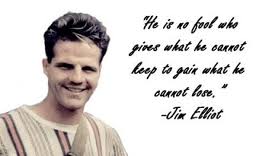
“He is no fool who gives what he cannot keep to gain what he cannot lose.”
“Grieve not, then, if your sons seem to desert you, but rejoice, rather, seeing the will of God done gladly.”
On Being Present
“Wherever you are, be all there! Live to the hilt every situation you believe to be the will of God.”
On Death
“When the time comes to die, make sure that all you have to do is die!”
On God’s Law
“Most laws condemn the soul and pronounce sentence. The result of the law of my God is perfect. It condemns but forgives. It restores—more than abundantly—what it takes away.”
On Living Boldly
“Forgive me for being so ordinary while claiming to know so extraordinary a God.”
“We are so utterly ordinary, so commonplace, while we profess to know a Power the Twentieth Century does not reckon with. But we are “harmless,” and therefore unharmed. We are spiritual pacifists, non-militants, conscientious objectors in this battle-to-the-death with principalities and powers in high places. Meekness must be had for contact with men, but brass, outspoken boldness is required to take part in the comradeship of the Cross. We are ‘sideliners’—coaching and criticizing the real wrestlers while content to sit by and leave the enemies of God unchallenged. The world cannot hate us, we are too much like its own. Oh that God would make us dangerous!”
On Evangelism
“Father, make of me a crisis man. Bring those I contact to decision. Let me not be a milepost on a single road; make me a fork, that men must turn one way or another on facing Christ in me.”
On Obedience
“Rest in this: it is His business to lead, command, impel, send, call or whatever you want to call it. It is your business to obey, follow, move, respond, or what have you.”
“I may no longer depend on pleasant impulses to bring me before the Lord. I must rather respond to principles I know to be right, whether I feel them to be enjoyable or not.”
BIOGRAPHY AND ADDITIONAL DETAILS OF HIS AND HIS FAMILIES SACRIFICE:
January 2, 1956, was the day that 28-year-old Jim Elliot had waited for most of his life. He jumped out of bed, dressed as quickly as he could, and got ready for the short flight over the thick Ecuador (Eck-wah-door) jungle. Almost three years of jungle ministry and many hours of planning and praying had led Jim to this day. Within hours, he and four other missionaries would be setting up camp in the territory of a dangerous and uncivilized Indian tribe known then as the Aucas (Ow-cuz), known now as the Waodani (Wah-o-dah-nee). The Aucas had killed all outsiders ever caught in their area. Even though it was dangerous, Jim Elliot had no doubt God wanted him to tell the Aucas about Jesus.
Growing Up
As a little boy growing up in Portland, Oregon, Jim Elliot listened carefully as visiting missionaries told about life on faraway missions fields. He asked them questions and dreamed about being a missionary himself some day. It made him sad that so many people in other countries died without knowing about God.
The Long Boat Trip
On February 2, 1952, Jim Elliot waved goodbye to his parents and boarded a ship for the 18-day trip from San Pedro, California to Quito (Kee-toe), Ecuador, South America.
He and his missionary partner, Pete Fleming, first spent a year in Quito learning to speak Spanish. Then they moved to Shandia (Shan-dee-ah), a small Quichua (Kee-chew-wah) Indian village to take the place of the retiring missionary. Jim and Pete studied hard to learn the language and fit in. Their hard work paid off; in six months, both were speaking Spanish well enough to move to Shandia. When they arrived in Shandia, they also had to learn the speech of the Quichuas.
Planning to reach the Aucas
Three years later many Quichuas had become faithful Christians. Jim now began to feel it was time to tell the Aucas about Jesus.
The Aucas had killed many Quichuas. They had also killed several workers at an oil company-drilling site near their territory. The oil company closed the site because everyone was afraid to work there. Jim knew the only way to stop the Aucas from killing was to tell them about Jesus. Jim and the four other Ecuador missionaries began to plan a way to show the Aucas they were friendly.
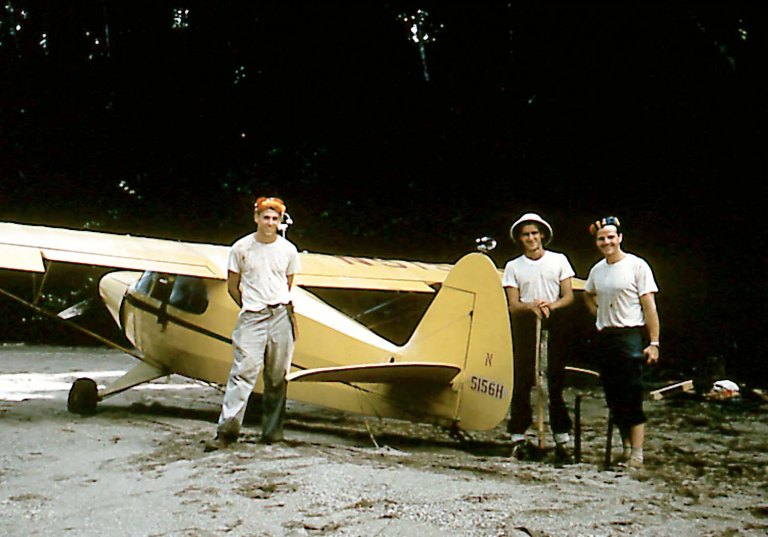
Nate Saint, a missionary supply pilot, came up with a way to lower a bucket filled with supplies to people on the ground while flying above them. He thought this would be a perfect way to win the trust of the Aucas without putting anyone in danger. They began dropping gifts to the Aucas. They also used an amplifier to speak out friendly Auca phrases. After many months, the Aucas even sent a gift back up in the bucket to the plane. Jim and the other missionaries felt the time had come to meet the Aucas face-to-face.
One day while flying over Auca territory, Nate Saint spotted a beach that looked long enough to land the plane on. He planned to land there and the men would build a tree house to stay safe in until friendly contact could be made.
The missionaries were flown in one-by-one and dropped off on the Auca beach. Nate Saint then flew over the Auca village and called for the Aucas to come to the beach. After four days, an Auca man and two women appeared. It was not easy for them to understand each other since the missionaries only knew a few Auca phrases. They shared a meal with them, and Nate took the man up for a flight in the plane. The missionaries tried to show sincere friendship and asked them to bring others next time.
For the next two days, the missionaries waited for other Aucas to return. Finally, on day six, two Auca women walked out of the jungle. Jim and Pete excitedly jumped in the river and waded over to them. As they got closer, these women did not appear friendly. Jim and Pete almost immediately heard a terrifying cry behind them. As they turned they saw a group of Auca warriors with their spears raised, ready to throw. Jim Elliot reached for the gun in his pocket. He had to decide instantly if he should use it. But he knew he couldn’t. Each of the missionaries had promised they would not kill an Auca who did not know Jesus to save himself from being killed. Within seconds, the Auca warriors threw their spears, killing all the missionaries: Ed McCully, Roger Youderian, Nate Saint, Pete Fleming and Jim Elliot.
Waiting to Hear
Late in the afternoon of Sunday, January 8, Elisabeth Elliot, Jim’s wife, waited by the two-way radio to hear Nate Saint and his wife discuss how things had gone that day. But there was no call. As evening turned to night, the wives grew worried. They knew the news was not good.
The next morning another missionary pilot flew over the beach to look for the men. He saw only the badly damaged plane on the beach.
News quickly spread around the world about the five missing missionaries. A United States search team went to the beach, found the missionaries’ bodies, and buried them.
But don’t think Operation Auca ended there, because it didn’t. In less than two years Elisabeth Elliot, her daughter Valerie, and Rachel Saint (Nate’s sister) were able to move to the Auca village. Many Aucas became Christians. They are now a friendly tribe. Missionaries, including Nate Saint’s son and his family, still live among the Aucas today.
Elisabeth Elliot even helped make a movie about Operation Auca called Through Gates of Splendor. It showed real life scenes of the five missionaries on the beach with the friendly Aucas. It also included footage of the two years she and her daughter spent living in an Auca village.
Jim’s Mission
During his life, Jim Elliot longed for more people to become missionaries. In his death, however, he probably inspired more people to go to other countries to share the love of Jesus than he ever could have in life.

 donsdevotions